A Complete Guide to Manage School Finances with School Management Software
- ERP SchoolAura

- Apr 8
- 4 min read
For school administrators, there is no denying that managing the school's finances is time-consuming and stressful. A little mistake by administrators costs schools dearly, and the bigger the school, the more complicated its financial accounts are. Relying on manual methods such as creating invoices by hand, maintaining physical records, and tracking payment details in a file is not the most efficient way to manage school finances.
Today, many schools are now adopting modern technologies like school ERP to simplify their administrative operations. By integrating a reliable accounting software, schools can improve their accounting processes, streamline daily financial transactions, and keep financial data well-organized.
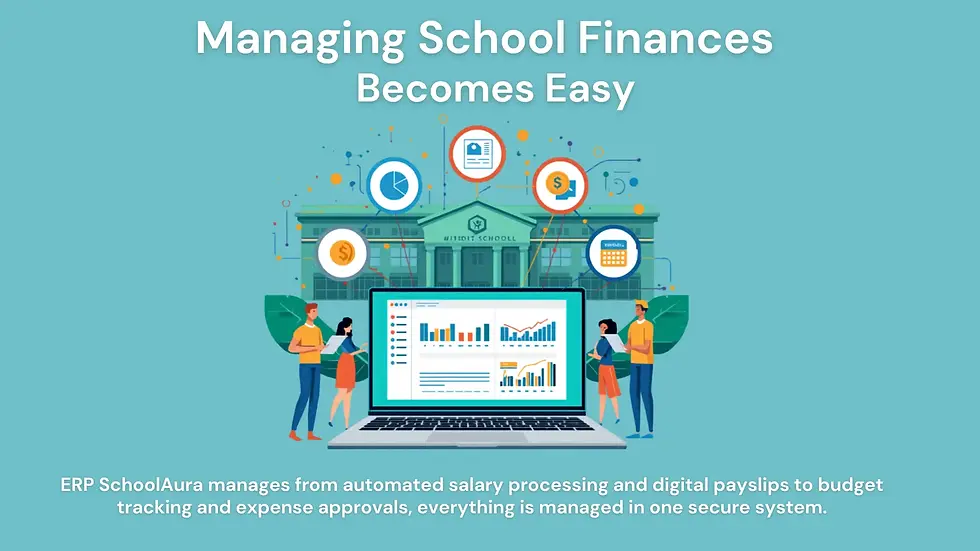
An account management system helps schools automate many accounting tasks, making financial management faster and more accurate. With access to smart features and centralized records, school administrators and accountants can handle financial activities more efficiently while saving valuable time.

Smart Finance and Accounts Management for Modern Schools
The finance and accounts management within school management software streamlines a school's financial activities, bringing order and clarity to the process. This module offers a comprehensive view of the institution's financial well-being, covering everything from income and expenditures to meticulous record-keeping. Given the complexity of school finances, which includes fee collection, expense tracking, and the generation of reports, manual management can be a real headache. An ERP software for schools eases these burdens, minimizing the potential for mistakes.
Core Functions of a School Account Management System
1. Organized Financial Records
With numerous financial activities such as fee collections, staff salaries, operational expenses, and event-related costs, keeping track of every transaction can become difficult. A school ERP records and ensures that all financial information is stored in a structured and easily accessible manner. Schools can view, manage, and create accounting and financial data with ease and in a structured manner.
One of the biggest advantages of digital accounting is the ability to keep financial records organized. Schools can store all financial data in a centralized database where every transaction is recorded with complete details.
This eliminates the need for maintaining multiple registers and ensures that financial information can be accessed whenever required.
2. Income and Expense Monitoring
Schools receive funds from various sources, including student fees, tuition, donations, and money from school activities. At the same time, they are responsible for managing their operating costs, such as salaries, maintenance, utilities, and educational resources.
A financial management system helps schools keep track of all their income and expenses. This allows school administrators to understand financial trends and monitor how money is spent.
3. Automated Financial Reporting
Preparing financial reports manually can take a lot of time and effort. With school management software, reports can be generated automatically based on recorded transactions.
Schools can quickly access important financial reports such as:
Cash flow reports
Donation reports
Financial Reports & Statements
Salary management and history
Transaction summaries
These reports help school management analyze financial performance and make better decisions.
Advantages of using an Accounting Management System
1. Save Time and Money
Daily accounting tasks like creating invoices and tracking different transactions (expenses, fees, admissions) when done manually are very time-consuming. By digitizing these tasks saves time while giving your accountant more space to focus on other areas.
With an accounting system, the school doesn’t need to hire multiple accountants (one or two is enough based on the school’s size). This way, the school saves money and gets some breathing room in their budget for other expenses.
2. Improve Data Visibility
An accounting management system provides the school board, the principal, and the administrative staff with data access. This is helpful in evaluating the school’s financial position, making changes in the annual budget and deciding if any additional expenses need to be cut off.
With access to real-time financial data, the administration can communicate with other departments about their expenses without any confusion. This data is also useful while planning a school event, allowing them to increase or decrease its budget based on their progress.
3. Minimize Errors
Manual bookkeeping and accounting tasks take up a lot of storage space. It also increases the chances of losing a document or misplacing it. With an accounting management module, the accountant can record, store, and organize bulks of data securely in cloud storage.
This way all accounting information is stored safely, without the risk of losing or misplacing it. When needed, the information can be accessed, exported, or shared with school members.
4. Increase Security
By using the accounting module, the school can make sure that all information regarding their finance remains protected in the cloud. This helps in preventing data leaks or hackers getting sensitive information.
The admin gets to decide who can access the school’s accounts and how much access they need. This is one way schools can protect sensitive financial information from being accessed without permission. Unlike manual bookkeeping, the accounting management system continuously backs up your data into the cloud, so the school won’t lose their data.
5. Real-time Financial Data
Tracking your school’s daily expenses is an important task. Within school management software, get real-time transaction data from departments for information regarding the money being spent.
This is advantageous in managing daily expenses, working on ways to optimize expenses, and getting an insight into which department has the highest expenses.
Connection with Other Modules
An accounting module is not one but is connected with other modules of the school management software. This enables the accountant to keep track of expenses and profits from other management modules (such as inventory, fees, admissions, donations, and transport).
With universal sync across modules, you can send notification reminders for any exceeding expenses, questionable purchases, or upcoming fee collection dates.
Final Thought: Future of School Finance
Managing finances is a vital responsibility for any educational institution. Without proper accounting systems, a school can face challenges in tracking expenses, generating reports, and maintaining financial transparency.
If your school is on the lookout for a way to ease financial management and user coordination, this school software is certainly worth a closer glance.
Stay tuned for next week’s post, where we’ll dive into school ERP's innovative attendance tracking and how it’s reshaping daily school life with just a few clicks. Until then, here’s to smoother days and happier schools!


Comments